Sales tax filing

Apr 2023

Ideal state 2026

We imagined what a perfect indirect tax world would look like 3 years out. The input was 40-some interviews with SMBs and accountants. This was just a few months after ChatGPT had launched, and while text wasn't yet a strong suit of LLMs, Midjourney proved to be extremely useful (and equally frustrating) for helping us visualize 4 key future scenarios.

Ideal state future scenario 1
Ideal state future scenario 2
Ideal state future scenario 3
2017

Historical context

Historically, sales tax had always been a compliance thing; it was never seen as a revenue opportunity. There had been an acquisition in 2017 and following that, an attempt to roll out filing in the US, but that hadn't stuck.

5 years later, the market for sales tax filing seemed a lot more attractive, and a new team got buy-in to build towards a profitable sales tax filing business.

May 2024

Foundational research into filing

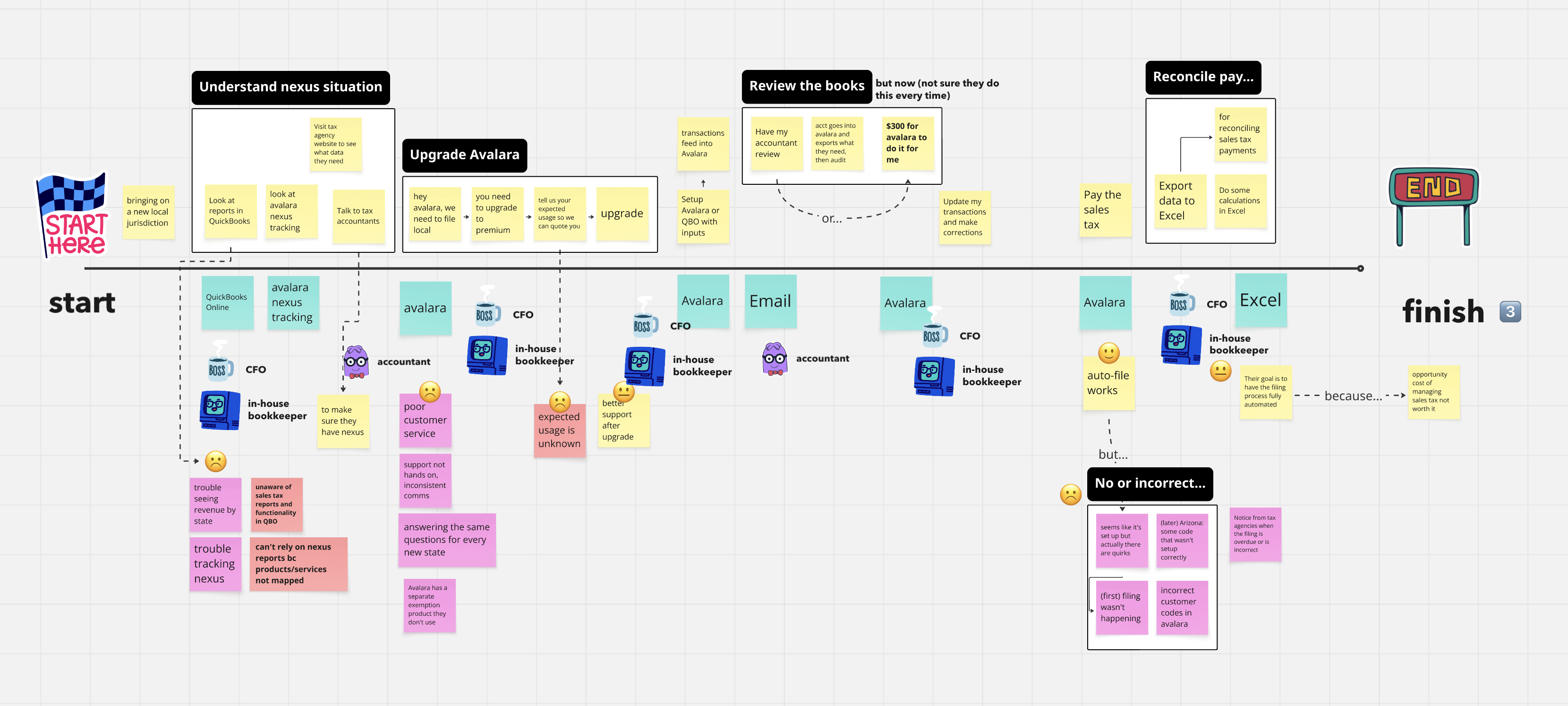
My first move was to deep dive into the filing journey, for both SMBs and accountants. To prepare for their sessions,I asked participants to map their filing process: actions, roles, tools, highs, and lows. The act of creation, and reflection in advance, gave me a headstart, and meant the output of our sessions had a lot more detail to it. I got about a 2/3 response to this request; with the remaining 1/3 we just mapped during the interview.

Participant filing process mapping canvas
One of the user journeys that the participant started before the session, then further detailed during. Edited for synthesis.

Insights

Almost everyone uses spreadsheets. To beat spreadsheets, we'd need to give users the right numbers to file, in the right format, out of the box. That would also puth us on the path of automation. But automation requires confidence in the books. And because of the complex nature of sales tax, that would prove to be a tall order.

The act of filing is a small part compared to setup, review, prep, crunching numbers in Excel, and cleaning up the books after.

Filing headaches add up as sales tax complexity increases: number of states, number of clients, complexity of state tax rules, and complexity of the business itself. Or any fun combination thereof.

Accountants express pain around dependency on their clients, especially when it comes to setting up and getting the right access. There is a clear mismatch between need to details, control by the accountant, but a lack of interest and attention to detail from the client. Not unique to sales tax!


January 2024

Mindsets

We were lucky to have a UX researcher on the team, who synthesized and crystallized a lot of past research into four indirect tax mindsets.

Detail Detective mindset illustration

Detail Detective

Cross-checks every line item and wants to see the math before signing off.

Macro Manager mindset illustration

Macro Manager

Stays at the dashboard level and delegates the granular filing work to others.

Cautious Conformist mindset illustration

Cautious Conformist

Follows the rules closely and needs reassurance that each step meets compliance.

Distracted Imperfectionist mindset illustration

Distracted Imperfectionist

Juggles too many priorities and accepts good enough if filing gets done on time.

These mindsets remain a helpful frame to this day when evaluating concepts and balancing user needs.

(I did not have a hand in creating these mindsets, other than some guidance along the way and the mindset avatars.)

Principles

Good design principles help you navigate tradeoffs consistently. We started out with unproven assumptions, and then formulated a more solid set of principles that were backed by what we had learned from users, the market, and best practice bookkeeping.

Where relevant, I connected each principle to one or more concrete pieces of UI in our filing prototype. Now we could link directly to the rationale—in context—when questions about designs and product behavior came up.

Filing system

Designing returns and filing flows for 45 states, with 6 or more statuses for a return, and different credentials, IDs, discount rules, tax types, ways to break down the taxes, and often a few other baffling esoteric requirements and edge cases, made it clear that designing and maintaining all of this as static mocks in Figma was not going to cut it.

I decided to build a config driven prototype. The Figma MCP was just starting to get decent, so all it took was a few .md files for config structure, point Cursor at a return UI design, and I was off to the races. Over time I swapped in components, patterns, and primitives from our design systems, instead of the LLMs imagining new styles and components with every prompt.

View the filing system prototype. (Press Cmd + K to switch between states and return statuses.)

A true sales tax agent

Most recently I've been exploring what a true autonomous sales tax agent would look like. Imagine you hired someone to take care of all of your sales tax, from setup, to calculation, filing, and cleanup.